


1 year, 0 screens, 100s of biomarkers
Powered by
Yes, it's really me
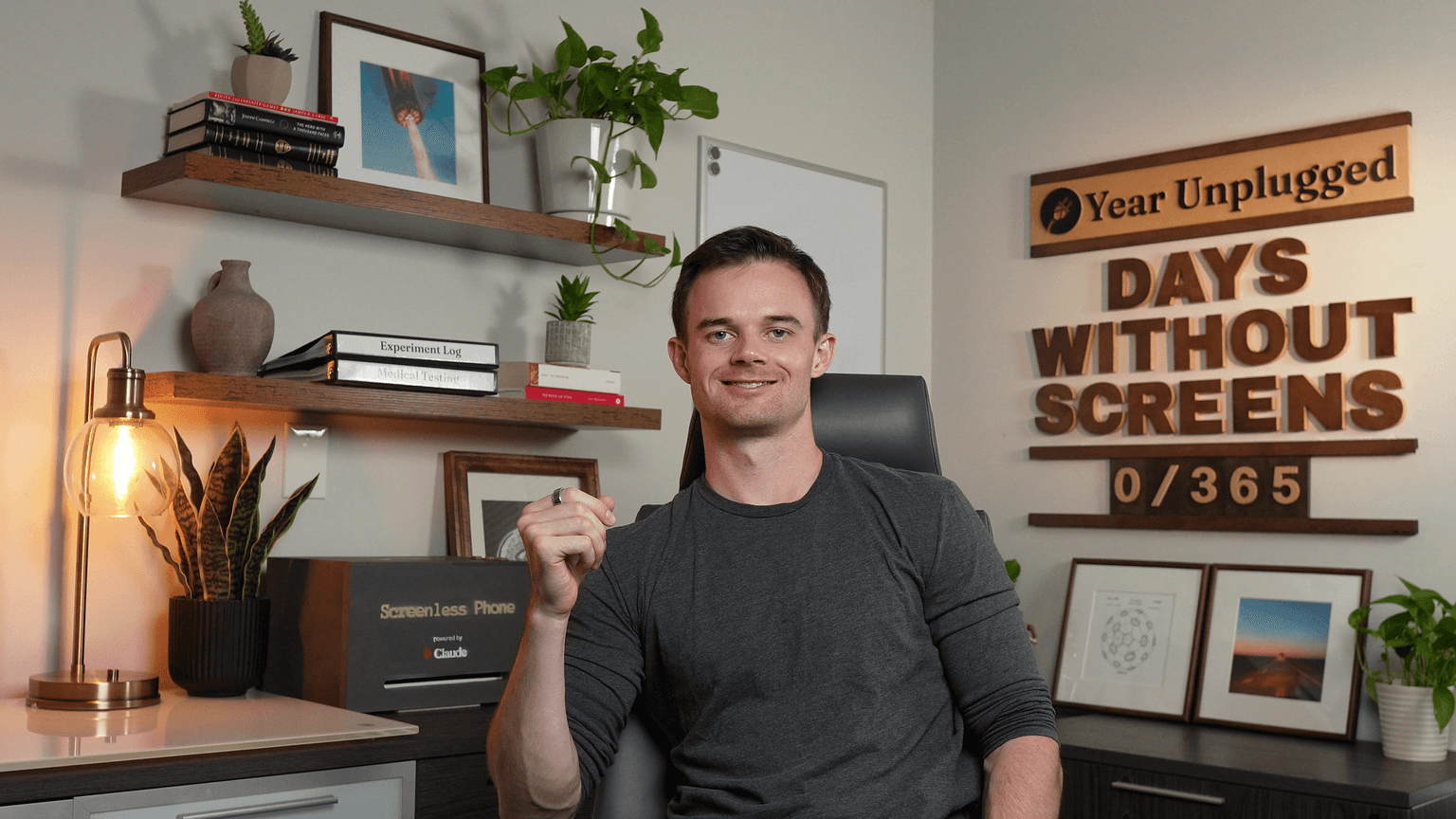
Hi, my name is David Daines, and on November 1, 2026, I gave up screens for an entire year.
Today is day 17.
Over these 365 days, I am scanning my brain, testing my blood, tracking my sleep, and more, to find out what you get back when the screens go away.
Here are the questions people ask most, in one place.
Frequently Asked Questions
What is Year Unplugged?
Year Unplugged is a one-year, one-person experiment I designed to answer a question: what is our relationship with technology costing us? And could there be a better way?
What counts as a screen?
No smartphone, no laptop, no tablet, no TV. I don't even have a Kindle.
Everyday screens don't count: tapping a grocery store checkout for ten seconds, a thermostat, a billboard on the side of the road. Even for these, I avoid them when I can, but this is about doing a good experiment, not solitary confinement. 99% elimination is enough.
Some of my medical testing — like cognitive tests — also requires looking at a screen, and I'm sure there will be screens when I attend a concert a few times over the year.
Are you still working?
Yes, this isn't a year off. This project is a big job, and I'll likely take on some consulting along the way. Either way, I'll be working all year, so if my stress changes, it won't be because I stopped working.
How are you posting without screens?
A small team edits and posts video content for me. As for my emails and X posts, I write them by hand, and my Screenless Phone posts them for me (you can see it behind me in the image above).
How does the Screenless Phone work?
I write commands on paper, put them in a slot, and a custom AI agent scans the text and follows my instructions: send an email, send a text, post to X, etc. Replies print out on paper.
Doesn't using technology at all defeat the purpose?
No, it's part of the purpose. Technology isn't going anywhere. But I think we deserve to know more about how it's affecting us, and we deserve devices that are friendlier to us.
Is this a clinical trial?
No, this is a one-person a.k.a. “N of 1” experiment. I keep most things steady, measure a lot (e.g. four different types of brain scans), and log what changes.
Screens affect how we sleep, move, work, and connect, so those “ripples” are part of what I'm measuring, in addition to things like brain scans, blood tests, cognitive tests, etc. I'm attempting to capture the full picture.
An N of 1 is how bigger questions often start: a previous one of mine is already becoming a clinical trial. If something striking shows up in my data, it's worth a closer look with more people.
What have you found so far?
I started out averaging eleven hours of screen time per day. Then it went to zero on November 1st.
Like my medical advisors and I expected, sleep was the first thing to improve. At the time of this writing, I'm sleeping an hour more per night on average. To see some of the data we've gathered, check out the biomarkers page.
And if you want to hear when new brain scans, IQ tests, etc. occur, get on the list.
More questions? Follow along.

Follow the experiment
Updates from a year without screens, straight to your inbox.
Do you still see social media comments?+
No, I do not. I decided it would be too distracting and detract from my experiment. Sometimes people tell me about comments, but I don't see them directly.